
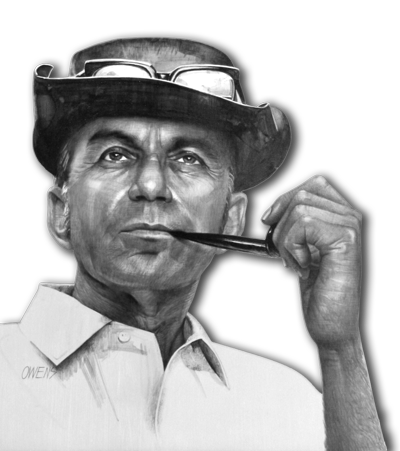
Thanks for following the link in PRI.
Below you can read samples of his autobiography: 1 - Best Damn Garage in Town and his legendary book on Chevy Small Block power: 2 - Power Secrets
excerpted from Best Damn Garage in Town by Smokey Yunick
© 2014 Carbon Press, Inc. All Rights Reserved
Foreskin
I know much that’s in this collection of memories, experiences and adventures, will be controversial…some will offend…some of it will be doubted.
I’m 75, and half way to 76 today…so in spite of taking three years to do this…maybe, just maybe, some of it is not 100% accurate. I’ve checked, double checked, and talked to the players still able talk…that in itself is a problem. If I ask Bud Moore, Ralph Moody, Tim Flock or Jack Smith, they all remember it a little different. I had, and have collected more data, and I’ve had a lot of help from people like Gene Granger and Don O’Reilly, (who had the foresight to hang on to a lot of data and pictures…that helps in reference to compiling a history book on stock car racing).
Anything without a past cannot have a future…rite? Auto racing history in the United States from day one till ten years ago is very, very fragmented, in reference to an accurate history of it’s conception and growth. Mainly because not a single sanctioning body has survived the journey, except NASCAR, and they threw the record of their first 20 years in the Daytona dump.
Margie, Kilroy and I, by 2001, have spent five years working on this project.
I decided three years ago this had to be two books, now it looks like it will be three. One about my life and two on the technical adventures and evolution. Since I’m an amateur book author I think first the year-and-a-half was wasted…I’ve since done it over (’bout three times). I now think I know what I’m doing. I’m sure I’ll be notified how you judge our project.
I’ll now save words and time, in reference to this collection as books.
What are these books about?
My interest is to recreate, as accurately as I can, the history of stock car racing in the United States, as I knew it, from 1938 to 2000.
I’ve injected myself into these pages as your guide. I believe I’m qualified for the guide job…I “talked the talk and walked the walk” from 1938…it’s now 2001, and I’m still talking and walking.
I realize no one is perfect, I realize that my observations and opinions are just that: one man’s view of a complex 60 or so years of racing history.
I think one of the most interesting questions a race fan has is “what is a racer?” So as an example, I include my journey through life and racing.
I think up to 1980, I was a typical example. I know the current racer is a different breed of cat.
Why did I spend so much time and effort to do this? To glorify Smokey Yunick? To make money? Because I hate NASCAR? Because I got a hard-on for the France’s? I’ve now learned fame is 99 percent limited to a very, very short span of time. My belief is, if this book was simply about myself, it would surprise me if 10,000 copies were sold. But I’m expecting, because it is a history book, it will be read by many people interested in auto racing for many reasons and that some good will be accomplished with it.
I’m not a rich man, but I can make it to the end without any hand outs. So it’s not for money.
About hating nascar. There ain’t no such thing. NASCAR is the France’s.
OK…we are down to not liking the France’s. I knew Big Bill as good as anybody did from 1946 till 1975.
I doubt Bill’s kids know that in the last two years of his life he would come to my shop and invite me to go fishing with him, fly with him to St. Louis to get an option on a super piece of property to build a race track – and I would own part of it. Bill then was a very sick man…I think he had Alzheimer’s disease (I don’t know that). It was obvious his memory was gone. He was, even on his last visit, happy. He had a special look on his face when he was happy. I can only describe it as the look on a little kid’s face when he’s just shit in his pants and he don’t want you to know it.
I was shocked at the visits. But when I realized Bill was no longer in a position to defend hisself, my negative feelings for him personally were gone.
One day, he said, “Smokey, I’m lonesome. We all worked so hard to get this thing going, I lost sight of some things, like friendship. Let’s go to the islands and go fishing and chase some pussy.”
Well, I had to turn away from him. I damn near cried. ’Bout that time his male escort herded him up and put him in the car. No, we never went fishing or to St. Louis to buy a track property. And we never went to any of the fifty lunch dates he made with me.
What are my feelings today about Big Bill?
Simply sadness. It could have and should have had a much nicer ending.
Now the rest of the France’s:
Annie…how the hell could anyone be mad at her? If she wasn’t a straight arrow there never was one.
Little Billy…you go by how people treat you in your process of categorizing each person who is involved in your personal life. My experiences with Little Bill were with a snotty, shit-head, rich and powerful man’s son. Remember, I left NASCAR in 1970. There’s no question in my mind Bill Jr. is no Smokey fan. And I can tell you I don’t light up with happiness every time I see him. Matter of fact last I saw him I got thinking, “if that dumb ass don’t lose some weight and quit puffing on all those cigarettes he ain’t gonna be here much longer.” But obviously my opinion of him in 1970 was way off the mark. He’s running a billion dollar circus and apparently doing it well.
Jim France…I know him very sparingly. He is a neighbor of mine, but if he walked in here rite now I’m not sure I’d recognize him. What little I knew about him, I rated him the “keeper” of the two.
So I got nothing to not like abut him. Matter of fact, my boy Smokey told me ’bout ten years ago that Jim France, in reply to a question about whether he would run NASCAR with Bill Jr., answered, “I’m 42 years old now. I never worked a day in my life and don’t intend to start now.” I liked that – I like honest people.
The son and daughter of Bill Jr., I don’t know them. I’ve heard the daughter is sharp, and the son is an asshole. Sure nothing ’bout them for me not to like (I don’t know them). My boy Sam went to high school with Brian and he seconded his asshole rating. (This has been confirmed by some press members that I know pretty good.)
Last thing: Is this book aimed at making me some sort of a hero? How you feel about yourself is the real reward if you operate in an arena where what you do or did gathers a lot of media attention. Daily, I still get an “atta boy” from one or more people, and when I shave in the morning, looking in the mirror, I’m at peace with myself. Sure, I did a lot of things I wouldn’t care to see on front page of the newspaper. But if you find some of them, and correctly print them, I’ll have no animosity to you.
I can handle the bad stuff when it’s the truth.
I wish I hadn’t done some of it, but I have another defense as well…half of the bad stuff I done I had no control over: “the devil made me do it.” As I’ve gotten older, I’m seeing the mistakes of judging people. I realize now it’s OK to have an opinion, just don’t play God and judge people. So now, instead of saying, “He is an asshole,” I say, “In my opinion he is an asshole.” Do you follow me?
Also, as I look in the mirror I think, “Goddam…you are lookin’ more and more every day like ten miles of bad road.”
Well, I’m well into the “golden years”…you know…where you’re half blind and deaf and all the stuff on your body you broke and abused is hurting and falling off. You got ten teeth left that have cost you fifty grand in the last fifteen years.
If hair on your head is to keep your brain warm, my brain would be froze solid.
One of the good things that happened to me in last twenty years is my wife Margie. She said this book needed to be. She has typed and retyped this thing for one million hours. She takes such good care of me, once in awhile I forget I’m out of warranty.
She says you are gonna enjoy reading this. If you’re not, chew her out, not me. It was her idea.
Really, I can’t tell you how good it makes me feel when people ask for my autograph or tell me what a great kid I was back in 19-0-something. That’s why I know the real reward is only how you feel about yourself. Everything else is temporary.
What you will read happened. Some will be offended by the language, how we lived, what we did…as I said earlier, I’m your guide. I lived it. If you don’t like the way it unfolds close the lid and call Margie and ask for your money back. (I doubt she’ll refund it though.)
I have no intentions of changing any of it to keep from pissing off major or minor players.
The things we did, said or tried to do can’t be changed. That’s the way it was.
For my part, it was an adventure that only a few got to take. I’m actually grateful I had a hand in the game. Would I change anything if I had the power to do it again with my changes? Yes…three changes.
#1 – Nobody would have been crippled or killed.
#2 – We would have won every race we run in.
#3 – I would have got to lay Marilyn Monroe one time.
I’ve discovered as you age, you run out of room for all that happened. I guess then, as the brain runs out of storage space, all medium and normal things are thrown out of memory, and you end up with just the very good and the very bad stuff that happened. So for those I don’t thank or mention who helped me, or for that matter were against me, I apologize in advance. Actually, now I don’t feel hard about people who gave me a hard time. How in the hell could you separate the good from the bad without some bad days? An example: Ray Fox did some things I considered very wrong. I wasted twenty years hating him, then got to revisit and spend some time with him, and discovered hell, he really is a very nice person, that used to be an asshole. Now I’m starting to have second thoughts about him again. Auto racing and its participants deserve a lot more attention from the hi-powered big business wizards. It’s the only profession in the world where you pay a fee for the right to work for nothing. How’s that for a way to cut the overhead?
The magnetism that auto racing projects I believe, is stronger than “day one,” and gets a little stronger every week. Why would a grown man cry when he failed to qualify for a race that could cost him his life? Pretty powerful stuff for those who deal in the behavior of modern humans.
The following I wrote for the readers of a book called Smokey Yunick’s Track Tech. To introduce and explain myself to the readers. I re-read the thing and decided why try to do it again – nothing has changed:
First thing I saw on the office wall at GM, when they hired me to run Chevrolet Racing (1955) was, “The price of progress is trouble” (Kettering). That man knew what the hell he was talking about.
1946-1976 – those 30 years were a blur of stock cars, trucks, boats, motorcycles, Indy cars, airplanes and helicopters. I worked 18 hours a day, seven days a week and found time besides to investigate most all of the immoral pleasures of socially unacceptable behavior. I lived like a running Southern dog, belly to the ground – tail straight out – ears straight back.
My formal education ended in the 10th grade, because by then I had developed a habit of eating two or three times a day. I’ve always had an attraction for speed and mechanical things. In the after World War II time frame, everything in life is timing. I didn’t know that, but for a curious-minded person addicted to speed, I was there at exactly the right time. Stock car racing was a format whereby everyone started even, next to no education and no money. A racer was a social outcast, no chance for credit, no insurance, not wanted in hotels, social status just a little better than an ex-con or a “mon-backer.”
In spite of all the drawbacks, to me, it was still a thrill on race day morning to walk into the pits, pull up my pants, look around and say, “All right you sons-of-bitches…let’s have a race.”
Being short on education, money, and friends – really all we had was each other. While we fought like tigers at the race track, we lived like gypsies and took care of each other in our own way. My adventures educated me to whatever status you give me. I’m grateful for the help, opportunities, knowledge, friendships and honors that have been afforded me in the now, 60-plus years. Although financial rewards are unbelievable now compared to then, I wouldn’t trade then for now for the world.
The only thing that I would change, had I the power, would be to delete the accidents where men were injured and suffered for the rest of their lives. For those who died quickly, I have no tears. We all knew what the risk was and accepted it. Respect and sadness were my emotions…the sadness passed, but the respect stays.
My mental justification was the world benefited with better surface transportation from our learning curve. I still observe what’s going on with great interest – puzzled by some of it…admire some of it. Some of it gives me a sense of nostalgic sadness but, I realize nothing is forever.
I’m 72 now, and I suppose as time passes, it’s hard to accept change from the way you thought was best. Racing as I lived it was an unknown sport. It’s now a mature modern complex engineering marvel. Maybe more of an entertainment event than a sport. I hope you find my adventures in racing interesting and for some who are headed up in racing, hopefully you’ll find something that will help you. I’m sure it is nowhere near as easy now as it was 55 years ago, but I think if you have the talent and desire, any average IQ can make it in racing. Some things are better: barriers for race, color or gender are gone. But racing is a Missouri sport show – “Show me.”
In the technical part of this book, even though it is dated, consider this, that which deals with physics and chemistry will never change. Nature and this planet dictates what we can and can’t do. However, there are many ways to skin a cat…and “how you skin the cat” is what will never stop changing. There are no limits to man’s ingenuity, just as man’s ingenuity will never conquer the forces and behavior of this planet.
What did I get out of 55 years? When I shave in the mornings and look at myself, I’m comfortable with myself and my life. I had my chance and feel in some special way, a sense of well being, as I continue to probe into another “what if” idea at my shop. Got no bosses, do what I want, don’t give a damn what any one thinks about it. Still work seven days a week because I want to. I’m a lucky man.
One winter day ’bout Christmas, 1970…a writer was here interviewing me for a story ’bout alternate energy. Said he was shocked with my small dirty office…dog bones on the floor…my greasy clothes. He asked me what kind of friends I had.
There was a pile of Christmas cards on the desk.
The phone rang…it was a call from Sweden on a Chevy problem.
As I talked he picked through the cards.
A couple of days ago, as I’m searching for something I wrote for Popular Science back then, I found the draft of his story. The cards he was impressed to see were from:
(Current, past or soon to be)
Pete Peterson, President, Ford Motor Company
Henry Ford, President, Ford Motor Company
Semon Knudsen, President, Ford Motor Company
Pete Estes, President, General Motors
McDonald, President, General Motors
Ed Cole, President, General Motors
Bob Anderson, Chairman, Rockwell International
Bob Mercer, Chairman, Goodyear
Lloyd Ruess, President, General Motors
John DeLorean, Vice President, General Motors
Bob Stemple, President, General Motors
So…would you agree I had some goddam good teachers?
Nope…no card from “Big Bill.”
My life from 1939 to 1975 was like a wide open train ride on the Orange Blossom Special…where it ran on parallel tracks to the Wabash Cannonball…seemed like it was never quite fast enough, and always so close to leaving the rails.
You know I don’t know how to exactly say this, but somehow in the background I could always hear this powerful, mournful whistle as we rocketed past dangerous breath-taking situations.
If there was ever a dull moment, I missed it.
A goofy idea I got in 1958 – I’d have liked to have Marty Robbins leading his band playing The Wabash Cannonball as we rolled out on pit road at Indy, race morning.
I asked him, ’bout it, he said “Yup, we’ll do it someday.” “Someday” will never happen.
Smokey
If you made it all the way down here, you’re hooked. Go ahead and click here to order Best Damn Garage in Town.
excerpted from Best Damn Garage in Town by Smokey Yunick
© 2014 Carbon Press, Inc. All Rights Reserved
The Mexican Road Race
“Carrea Panamerica” means “Mexican Road Race” in Spanish. I don’t know who dreamt this deal up, but if it had a main sponsor, it should have been the morticians of Mexico. Marshall Teague wanted to run a Hornet in the ’52 race. Hudson says, “Yeah, we like that…here’s ’bout 5,000 dollars…go tear ’em up!” We got three Hornets: a race car, a tow car, and another Hornet to pull a two wheel supply trailer. In the race it’s Marshall and co-driver Les Snow. Les is a driver, and a pretty good one, from some rough suburb of Chicago…a nice guy. Also a damn good mechanic in general, though not an engine ace. One guy on the crew was from Marshall’s gas station, Harry Van Driel. Harry was a damn good general mechanic and is still around. If I missed someone, I apologize.
We got ’bout 50 bucks a week and expenses. Some motor companies spent a fortune to try and win. Lincoln-Mercury were big spenders, with maybe the greatest mechanic that ever lived, Clay Smith as their main man. Watching Clay’s behavior, and absorbing his preparation…it was a treat to watch one of our peers show you how it should be done: so perfectly and with seemingly effortless execution. Clay Smith was a genius. Probably the greatest so-called “racing mechanic” in the world at the time. But none of his ability impressed me as much as his helping his competitors with advice, and sometimes materials and tools. I’d watch him at 1:00 am, knowing he was as tired as I was, in the garage where we were preparing the cars for tomorrow’s run. He would go help a competitor fix his carburetor so it wouldn’t flood. True, the Lincoln budget was light years ahead of us, but he still had time for anyone who asked him for help. He did this in boats, Indy cars, midgets and stock cars. He even ground his own cam shafts. I think his 1st year to Indy, his car sat on the pole with a rookie driver, Walt Faulkner. In three point hydro in both classes…(racing boats) we run Ford 60s and Ford 85s…this was in the early 50s…I worked my ass off to beat him. Next week he’d come back and beat us again. The sad thing really is, to this day, racing has never come close to recognizing his contribution to helping build the foundation U.S. auto racing sits on. You know what really makes Clay Smith story so sad? He was killed at a way early age by his own race car. A sprinter that lost control coming off turn 2, and got in the pits and “nailed” him. The driver was one of Clay’s best buddies.
Back to the race. There are a thousand stories ’bout the Mexican Road Race. Hell, in 1950 Bill France, Sr. and Curtis Turner co-drove an “up-side-down bathtub” (Nash) in the race. Well, we drive down through Matamoras (Brownsville, Texas). We have been told all kinds of horror stories ’bout the bad roads soon as you enter Mexico…(’cept the Pan American’ hi-way to El Paso). I’m driving one Hornet, towing the race car. We cross over into Mexico and hell, it’s a good paved three lanes…for three miles.
Turn a corner…Bam!… running 60 and the asphalt stops no, one lane dirt… wrong road? turn around? down a little hill… hard turn… pow!! Wheeeeeee!!…river…no bridge… whooooeeeee… goddam near drove ’er in a small river. The river’s got a flat deck barge, but river is way up from too much rain, (yet when we crossed the Rio Grande in Brownsville, it was damn near bone dry)… river’s too wild… can’t cross. Turns out five bucks gets river crossable (barely). Really, that was a very hazardous crossing. We could have lost everything we had. A single cable keeps barge from getting out of hand and you pull yourself across with rope-hand-power. Well, we manage the skinny, rough roads until we find the Pan American hi-way to Mexico City. (From there to Mexico City, roads good…very good) Mexico City…everything’s same as today I think, ’cept then it was 90 percent smaller. Traffic rules are Russian roulette, kinda “don’t let the other guy see your eyeballs.” It’s actually a game of “chicken.” There were no traffic lights there. A very loud horn was best driving aid.
In Mexico City we work on car at the Hudson dealership. We can’t speak Spanish, but the dealer’s got a 15 or 16 year old son. A real nice guy and helper. He’s going with us as our interpreter. (Good idea as it turned out.) Gotta have a place to stay for five days. Taxi driver says ,“Go to Angel’s, best place in town.” Angel’s is a big house, 15 bucks a day for room and three meals…free booze part of rent…free hookers and dirty movies all day and night…all for 15 bucks a day. Yes, it was all good…for a dose of the crabs…quite an interesting place.
The owner took a liking to our driver. I observed her giving oral sex to him with a condom on. That puzzled and amused me. Actually…Les Snow, the co-driver, brought it to my attention… it was as interesting, I think, as the discovery I had made a few minutes earlier. After Les guided me to the room where our landlady was attempting to relax the driver, I then showed him my startling discovery. Remember, I said, “whiskey no charge.” Well, if a tenant had sex with a waitress or bartender, an old lady would come in room after, and wash your sex parts with whiskey. Makes sense right? Well, on the second day I notice a door and I wonder, “Where does that go?” So, I open door and am startled to see an old lady pouring whiskey out of wash basins into a funnel stuck into a whiskey bottle. I realize, “Hey! That’s what we were drinking”… (No wonder it had an unusual flavor) We soon solved that problem. We were able to buy a quart of good whiskey for ’bout three bucks.
I will always have a fond spot in my heart for Angel’s place. Those young ladies actually taught me some things that the Californian’s hadn’t got to yet…(the deal with the beads in particular). Although that deal actually had a few draw backs – I got no rest at all. I told you about acquiring a group of annoying passengers in an area you see baseball players scratch all the time. Every time I see it on TV, I smile and say, “Wonder if they been to Angel’s?” Piggins had made arrangements for us to stay in a private home in Mexico City, so when Les and I turned in our expenses, (5 days, $75 as medical expenses for the “Inca flu”). Piggins disallowed the expenses. I guess he was pissed we didn’t invite him over there.
I’m really grateful to Marshall for including me in the race. It was an experience. When Marshall first invited me, I understood I was gonna be a co-driver. Now, co-drivers never drove. They just sat in right side of front seat and hollered…“Watch it!”…“Slow down!”…“Turn right you dumb shit or you’ll never make it!”…“Whoo-ee!”…“Oh-shit!”…or when you passed someone in your class, give ’em the finger. But when the time came, Les got the co-driver job. The race was run on a new paved road (two lane) that run from El Paso in the United States to Tuxtla, at southern end of Mexico at beginning of Central America. One-half mile south of town, road went to jungle… not even dirt road. The Pan American hi-way race was 1,934 miles long in 1952, we ran it in five days: 1st leg: Tuxtla to Oaxaca; 2nd leg: Oaxaca to Puebla; 3rd leg: Puebla to Mexico City; 4th leg: Mexico City to Leon, 5th leg: Leon to Durango; 6th leg: Durango to Porral; 7th leg: Porral to Chihuahua; 8th leg: Chihuahua to Juarez. The race was a mountain road race, on a typical mountain…sharp turns… always either gaining or losing altitude…with no goddam guard rails and plenty of 5,000 foot straight down drops in case you slid off. Damn rite, somebody got wiped out ’bout every day… and sometimes spectators…actually, 26 people (mostly spectators) died in five years.
I left out something regarding Mexican culture and law. Radios and guns…it was not legal to have a radio capable of any distance to speak of…so getting car in country with radio was a son-of-a-bitch…and if that radio was gone when you tried to leave country…that was hell. So guess what would get stolen quicker than a cat could lick it’s ass? Right…the radio. I took radio out, and antenna off, and hid them in with spare parts. Guns? gave ’em away in Brownsville coming in when I heard how that worked. More about guns later.
Now the little town where race started, is at the southern very end of Mexico. This is mountain… dry, poor, old-old town, but they had a Ford dealership there that was one half block square (inside). This dealership had a huge parts department. Very few cars, new or used…but at least one of every kind of tool to work on Fords, Lincolns and Mercurys made in the world, and take my word for it, them cats knew how to use ’em. They had some uncanny metal, or body men…threw away damn near nothing…straightened everything…like big Cadillac bumperette…How? Split ’em in four pieces… straightened each piece, then welded back together. They had a chrome plating facility that amazed me. The Mexican state troopers all run Mercurys. A wild bunch…you haven’t lived until you get on latin country roads, including cities. No traffic lights, big-assed loud horns, and the code of the hills is “big is better”…so 100,000 pound tractor and trailer double, owned the road. (Yes, they had them…pulled by French tractors where 15 year old kids rode on both front fenders and hand oiled the valve gear… huge engines, diesel, ’bout 1,000 cubic inches.) For some reason these Latino truckers ride in the middle of a two lane hi-crown road and drive like a “bat out of hell.” I swear, when they wind down out of the mountains and hit a town, they add 30 miles per hour and blow the horn like a freight train going through Fayetteville. Most Latinos can’t drive worth a shit, but some of them cats with a little experience and good equipment, can race any son-of-a-bitch in the world.
Back to the Carerra Panamerica. OK… Here’s how it works. Race starts around 6:00 or 7:00 am in morning (first daylight)…cars are flagged off a couple minutes apart… ’bout 10 classes, so “hot dogs” go first. Idea is to keep “hot dogs” from wading through “slow stuff.” This is a real road course – no fences or guard rails either. The way they kept people and animals back, or kept regular cars off the road was to station soldiers within sight distance of each other on alternating sides of the road. (By the way, they drive on same side of the road we do.) It’s a simple deal…in the race hours the road’s closed. If an animal or human attempts to cross during the forbidden hours, the soldier shoots your ass “to kill.” The race I was in, a young man right on outskirts of Tuxtla, crossed the road…soldier shot and killed him. A friend of mine, (well actually a friend of any racer), Don O’Reilly, had a magazine called “Speed Age” and witnessed this deal. He like to went “ape-shit” over it. I seen him a few months ago at his house, and we talked about the killing.
OK…pit crew: at the end of every “leg” you got lots of things to fix. (Reference: sliding off the road, tires, broken engine) so the pit crew gets cars ready to race, then you drive your ass off all night to get to next check-point, cause if you don’t make it by “road closing,” it’s over for that team. Well, “we” (the Hudson team) are the Mexican Hudson dealer’s son, Marshall’s mechanic/employee, hi-buck 10-dollar-a-day-man Harry Van Driel and myself. The back of car is full of parts and tools, and we are pulling a two wheel trailer loaded with tires, parts and fuel. We had to carry everything we needed. At that time in Mexico, a gas station was a collection of 50 gallon drums along the road at a house. You stop…toot your horn and maybe. We all ride in front seat…either Harry or I drive. Let’s call the son, (’bout 15) José OK? (I forgot his real name, sorry.). José is our interpreter, and a damn good one. Can speak English super…we have to really haul ass to get to next race checkpoint. First night, just ’bout midnight on Isthmus of Tojuanapec Road on the only straight level ground in whole race, (’bout sea level), all of a sudden… road block (with driftwood)! I’m asleep…car is lurching…tires screeching…horn blowing…guns going off. Harry, the dumb shit has decided to run through the road block, running ’bout 90, with the trailer flying all over hell behind. As I look in rear view mirror, I see what looks like career-ending flying experiment of a Mexican highway bandito. The trailer catches him, and he gets a trampoline type launch from the swinging trailer. I think “Harry can file at least one notch on side of the steering wheel”…(but probably two)…or we can paint something on side of car (kinda’ like fighter planes did in war for a shot down enemy) …well nothing broke.
Next night Harry’s driving again, I’m opposite side…José in middle. Hear brakes, then down-shift and wide-ass open engine. José’s hollerin’ “Stop!!!”…I look up… horses lined up across road, and up each bank…’bout 20 of ’em…all got rifles, and they are coming down. Twenty rifles are aimed at the windshield. I reach over, turn key off. Harry gets ’er whoa’ed ’bout five feet from the end of twenty rifle gun barrels. The boss-man is ’bout five foot four tall by five foot four around; got glasses and a mustache; got a “general” kinda hat with a strap to hold it on when his horse is going real fast. I can’t understand him, but he is pissed! And Jose is talking his little diplomatic ass off to keep Harry from being turned into a very dead gringo son-of-a-bitch. (You know Harry, I doubt you have any idea how close you came to having a rock sitting in a cemetery, where the last thing on it said “1952.”) Well ’bout nine-ten bucks was cost of “permission” to continue on our mission to next check-point at Oaxaca… You’d think by now I’d get thinking and put Harry’s ass in the trailer and drive myself. Nope, I need some rest…ain’t no way in hell it’s gonna happen again rite?…so I doze off. Now we’re in bad very-very twisty mountains, ’bout 4:00 am, Getting close to check point – one to one and a half hours out. Car’s slowing… I hear José raising hell with Harry. I wake up…we are damn near stopped, going up real steep hill. I see ’bout 20 Mexicans…rocks across the road. One cat had a pistol…’bout 10 with machetes. Whoa Nellie! I wind window down…I’m opposite Harry, Jose in middle. Mr. Bandito is shit-faced drunk… Got a pistol with ’bout an 18 inch barrel, and he sticks it in my right ear. Harry don’t see the pistol, and as men move around in front of car, and José tries to negotiate a peaceful arrangement which will let us continue to Oaxaca without any leaks in our blood carrying equipment, (engine’s still running). I hear Harry say, “I’m gonna floor it and take off – road is clear now.” I say, “Harry, before you do, check over here and see what’s sticking in my right ear and note the drunken and unhappy attitude of the cat that’s holding it.” Well ’bout two quarts of wine (a departure present from the ladies at Angel’s), about three or four bucks and one five gallon can of gas cured that deal. We get to Oaxaca an hour before road closure, so I decide to notify authorities about our terrible experiences. (Get the cops in the deal.) José says, “I don’t think so”…I say, “Bullshit,” so we go. It ain’t far. Still dark as hell. As I walk into station I damn near have a heart attack. There sits Mr. Five Foot Four’s twin brother (the horse bandit)…even the same clothes – boots and hat. I know it’s impossible for it to be the same man…no vehicle passed us all night. Or was it the same man?…maybe there’s another road? Anyway, José explains whole terrible deal. Mr. Mexican general rolls to the side, lets out a big fart, and eats José’s ass out, and tells us, “Get our ass over to check-point garage and keep our damn mouths shut, or our ass is in jail.” “OK, OK’… I’ve heard ’bout Mexican jails, and we ain’t hurt. “Come to think about it, maybe it never happened…maybe I dreamt it.” We got our stuff out to do our work, but still got to wait four or five hours. An American tourist…(big trout fisherman…fly rod champion of the world I think) is a Hudson Hornet lover, matter of fact, has a year old Hornet right outside. He can’t go till race cars come and go (remember the system…“road closed to public and animals for a time.”) He tells me about Mexican’s trying to hold him up. He was fishing some place to our west, and came onto the Pan American highway ’bout 20 miles before “Mr. Long barrel pistol.” They set up a road block with small rocks. He got scared and pulled a “Harry Van Driel,” and run the road block. I said, “Did they shoot at you?…Did it hurt your car?” “Hell no!…I’m a good driver!”…I then notice a dark puddle under the engine, and a wet looking place at rear of the car, so I get a light and get close… You guessed it: oil and gas leaking. Turned out “Mr. Good Hudson driver” had ’bout no oil in oil pan (a rock from road block caused oil pan to flunk the “hit a rock with the oil pan at 60 miles per hour test”) and “Mr. Very Lucky Champion Fly Fisherman Hudson-loving Good Driver-lucky Son-of-a-bitch, only had 22, yup…22 bullet holes in back of his “lucky black Hornet.” Well “Lucky” decided he wanted to talk to the American ambassador to Mexico…said he knew him (maybe he gave him a free fish) about this outrage. So I directed him to the military headquarters and “General Fat-ass.” I don’t know what happened, but we left ’bout four hours later, and the “lucky black trout fishin’ Hornet” with 22 bullet holes in it was still sittin’ there, and the puddle of oil under engine was ’bout two foot in diameter. If you’re still living “Mr. Champion Fisherman,” I’d appreciate a note from you telling me how that deal ended. From there on, I never got to meet any more Mexican bandits, but I kinda’ have a little idea how those people felt when they were on the stage coaches and they were attacked and robbed. I guess it’s tougher the way we had it, cause only José knew what the bad guy was saying. (You know, Harry might have been a stage coach driver in a previous life.)
Another thing I haven’t mentioned was the goofy spectators. Wherever anybody run off the road and got killed last year, that’s where there would be 4,000 people – rite up to the edge of the road, and as a rule on the outside of turns. Then in Mexico City, you’re coming in straight…running over a hundred…you’ve been off the road three or four times front and back. (What’s the tires look like?). There’s damn near a million people lined up for four or five miles with their toes on edge of asphalt, and you’re going by ’em at over 100, rubbing your left and right door handles against their tits. What if a tire lets go? Those in back shoved those in front, and they couldn’t back up. No, it never happened…maybe courtesy of the Inca gods…but in general, few races in the world extracted an unacceptable high cost in lives, sheet time, and inconvenience to the citizens as the Mexican road race. The same thing, reference crowds, happened coming into Juarez at end of the race.
Clay Smith and his Lincolns, and Bill Stroppe and his Mercurys dominated those races. Marshall and Les did pretty good. I think they ran from fifth, and I believe ended up seventh in stock car class and thirteenth overall. The whole deal took ’bout 22 hours racing time. Hershel McGriff, from Portland Oregon, won the first race which changed his life forever. I remember the car. An Olds 88, with a clever sign on it from Portland, Oregon “For You in Portland, a Rose Grows”… Who in the hell ever heard of a sponsor who sold roses in early ’50s? Hershel I guess is still going… He turned out to be very good, and last I heard was ’bout 70, and still winning.
The Mexican Road Race was a wild chapter in American racing’s early experiments while trying to find it’s way, or to find a place where those who loved to go fast went to hear those loud, tortured engines. The hope was to establish at least an annual event that could fund the competitors sufficiently so that they could do it one more time next year. There are attempts to re-establish parts of that exciting time…but men, you missed the boat. It has come, and it has gone…like the Pony Express.
Mercedes won the race with a gull-wing coupe, with, I believe, a German driver (in 1952). John Fitch, a yankee American driver, was at his prime, and really doing the best job…but poor John got screwed by the Germans. They wanted a German driver to win, and as I remember, they had four or five cars in the race. At race end, Fitch gets disqualified cause he can’t curse in German, and Karl Kling, a German race hero got the marbles. The Mexican Road Race ran many classes…from the fastest sports cars in the world to stock car to little shit-box sports cars with ’bout 100 horsepower at 8,000 rpm. So this race was between Mercedes and Ferrari. I guess the four things I remember most were: Number One – Angel’s guest accommodations. Number Two – watching and working with Clay Smith. In my book Clay, you’re “#1” by a ton. Number Three – The pit action of Ferrari and Mercedes…particularly the Germans: they performed as an army exhibition marching team, like robots with human minds. Watching John Fitch die a million deaths trying to get his car repaired (he developed brake trouble) But the real act was Ferrari.
No Keystone Cop movie can ever match the act those 20 “dago” mechanics, drivers and staff, put on at every pit stop. They were poorly equipped in all ways but bodies. At mid-point of a day’s running, you have to fuel – change tires – and as a rule, change drivers…(Only the hottest sports cars had professional sports car drivers). Remember all these had co-drivers…(Some dumb shit who strapped his ass down in right hand seat, or left hand, as case might be) to yell at driver his observations, opinions, advice and/or criticism. Driving a race car is, as a rule, fun. But be a passenger in a fast car with a great driver, or even worse, with some terrible driver with tons of money and the balls of an elephant…and do this five to 10 hours a day for four or five days. As far as I’m concerned, is like sitting in an electric chair for that amount of time waiting on them to fix a problem in the system so they can fry your ass. Well, the drivers jump out, after sliding a quarter of a mile, and ending up running over their pit set-up. Why?…he is headed for the shit house… remember he’s on ’bout on his fifth day of Mexican food. During a Carrera Panamerica stop, besides changing tires, (and fueling in case of sports cars), you had to, for sure, replace brake pads, and fix or “band-aid” whatever else is “not doing it.” The Ferrari tire changers best act was to drop car without the wheel on yet…or put front tire on rear, or vise-versa. The fuelers, (with cans), dumping gas all over everybody and everything…and sometimes catch car on fire on re-start. The “soakers” getting smacked by the “soak-ee’s” and the “soak-ee” attempting to dump gas on “soaker” to get even. But by far the best act was the water boys. They used garden water cans, (like your grandmother used to water her garden…with built in funnel…held ’bout a gallon and a half). The Ferraris run hot…so as tires, fuel and brake pad were being done, two to four guys open hood and start dumping water on radiator and into radiator. In the process, the brake pad, and/or tire guy, gets an unexpected bath, which pisses him off…so he jumps up, grabs the bucket and dumps it on radiator man, or the contest is even, and two guys are in a “bucket pulling contest,” during which, driver accidentally gets a bucket of water down his helmet and back. Now mix in ’bout five officials, who don’t know what the hell they’re doing either, and Ferrari staff and race brass get into it…so now you got a mixture of Italian-Spanish, and maybe some English, French and German…cursing and lots of pushing and pulling…rule books, pit boards, and “motherfucker” in three to four languages. In addition to this, is a hoard of afficionados: ex-racers, wannabe racers, rich fans, about ten “Miss Italy’s,” and the news media (no TV yet). Every once in awhile throw in a Mexican policeman and farmer… (Wantin’ to get paid, or “put your ass in jail” for a cow, donkey, pet or chickens you ran over last year.) And in Pueblo, a teen-age young lady with ’bout a three month old baby. Seems like a driver last year left some of his seeds with the little lady, and she wanted to talk to that driver about marriage, and a home in Italy…and it seemed like her father and brother had a different plan. They wanted to kill the son of a bitch. (This was in Ferrari pit.) Since big sports cars started first, and run fastest, we got to watch the deal from best seats before our cars came in. Number Four – the Mexican hi-way banditos, and their version on how to run a toll-road without any investment in it. Maybe Number Five could have been the “Inca trot,” caused by not being cursed by it in Mexico City at Angel’s, and my assumption, “I can drink the water and eat the vegetables…it don’t bother me.” I left a trail from Tuxtla to El Paso, and back into Florida…but it helped in later life, during the early sixties in my adventures in the jungle oil fields and gold mines in the Ecuadorian Oriente, I did not challenge the local medical wisdom of how to avoid the “toilet paper boogie.”
Racing needed this five days of stupidity to guide us…but we didn’t know it was a mistake until we did it…though it sure was a shame so many died. Actually, considering the scope of the race, the management did a hell of a job when you think of all the details of such an event. For those who would re-create this race today…some advice: just assemble all drivers in an auditorium and play Russian roulette instead. This spares the people who live on the race’s proposed route the loss of several days of their lives, and the almost sure loss of several lives. Racing has “been there and done that.” I learned one sentence “besame culo” in Spanish…(means “kiss my ass) and two Spanish words: “Adios” and “gracias.”
“Adios” Carrera Panamerica… and “gracias.”
If you made it all the way down here, you’re hooked. Go ahead and click here to order Best Damn Garage in Town.
excerpted from Power Secrets by Smokey Yunick
© 2014 Carbon Press, Inc. All Rights Reserved
Table of Contents
1. Cylinder Blocks
Bore Versus Stroke, Block Selection, Aluminum Blocks, Siamesed Bores, Crankshaft Bore, Bearings, Bearing Caps, Cylinder Bores, Block Decks, Clearance Check, Mock-Up Assembly, Studs, Cleanup
2. Crankshaft & Rods
Crankshaft Selection, Stroke Length, Crankshaft Weight, Crankshaft Preparation, Clearance Checks, Lubrication, Balancing, Flywheels and Balancers, Rod Selection, Rod Length, Piston Pins, Chevy Rods
3. Piston & Piston Rings
Basic Piston Design, Skirt Clearance, Compression Ratio, Dome Shape, Quench Clearance and Deck-Height, Piston Rings, Ring Width, Ring Placement, Pin Height and Rod Length, Ring Material, Ring Fitting, Leak Testing, Finishing
4. Cylinder Heads & Induction Systems
Development, Cylinder Head Preparation, Airflow Testing, Airflow Balance, Valves Size, Intake Port, Exhaust Port, Valve Seats and Faces, Machining & Assembly, Head Milling, Head Mounting, Intake Manifolds, Port Matching, Carburetors
5. Camshaft & Valvetrain
Selection, Development, Engine Requirements, Operation, Valve Timing, Lobe-Separation Angle, Crossover, Lift, Valvetrain Weight, Lifters, Push Rods, Rockerarms, Rocker Mounts, Valve Springs, Geometry, Interference Problems, Cam Drives, Cam Thrust Bearing, Lubrication, Degreeing
6. Exhaust & Ignition
Ignitions, Misfire & Crossfire, Plug Wires, Breakerless Distributors, Ignition Advance, Multi-Coil Ignitions, Spark Plugs, Headers, Header Functioning, Conventional Header Guidelines, Heat Retention, Equal-Pulse Headers
7. Lubrication & Cooling
Lubricating Oil, Oil Temperature & Pressure, Block Modifications, Wet-Sump Systems, Dry-Sump Systems, Oil Routing, Cooling, Coolant Flow, Coolant Temp, Water Pumps
Fan & Radiator, Drive Belts, Overflow Systems
Smokey’s Tool Box
Smokey’s Parts Bin
If you already know everything there is to know about the above topics, this book isn’t for you.
If you don’t know, then click here to buy your copy in our store.
excerpted from Power Secrets by Smokey Yunick
© 2014 Carbon Press, Inc. All Rights Reserved
Chapter 1
When you’re selecting a bare cylinder block for a stock-block endurance-racing engine, you generally don’t have much to chose from. The last time I checked, each of the major manufacturers offered only one type of so-called “heavy-duty” cylinder block that had some special features to make it more desirable for racing. Sometimes these blocks have thicker cross-sections in critical stress areas and they usually have four-bolt main bearing caps. The specific design and materials used in these heavy-duty blocks seem to vary from time to time, but unless the class rules allow some sort of specially-made aftermarket block you will have to use the currently available factory heavy-duty block.
I’m not going spend time listing a bunch of factory part numbers. These things change faster than I can keep track of them, and the numbers I write down today could be obsolete tomorrow. Besides, most of the hot-rod magazines regularly publish up-to-date information about the latest factory performance parts and most of the major Detroit manufacturers have detailed catalogs that list their current selection of heavy-duty components. I would recommend that you just buy whatever they say is best. In this book I will concentrate on general concepts that I believe are important, and the reader will hopefully be able to apply this same thinking to whatever specific component or engine he is racing.
BORE VERSUS STROKE
With some engines you may have a choice between bare cylinder blocks that have a different bore diameter. The small block Chevy is a good example. The most popular currently available blocks have bore diameters of 4 inches or 4.125 inches. This presents an interesting possibility. If you are racing in a class that is limited by displacement – and most are – would it be better to build an engine with a 4-inch bore and a longer stroke or would it be better to use the block with a 4.125-inch bore and shorten the stroke?
Racers have been arguing this matter for years, and there is no simple answer to the question. lt depends on many things. Generally, if you produce an engine with a relatively long stroke, it will develop more torque because of the greater leverage created by the longer arm (lever) of the crank. An extreme example is the typical diesel powerplant used in large earth-moving equipment. Some of these engines have stroke lengths measured in feet, and they develop tremendous amounts of torque at very low engine speeds – 800-900 rpm. However, an engine with a longer stroke must be larger and heavier to accommodate the relatively large crankshaft, and such an engine is unmanageable when overall weight and size are important – as is the case in a high-speed race car.
In addition, the heavy weight of the internal components limits the practical engine speed (rpm) of the engine. It is possible to overcome this limitation somewhat with gearing – though the required gear train would not be very practical – but in general, an engine with an extremely long stroke length is not suitable for most high-speed racing applications. On the other hand, if horsepower is the prime consideration, it is better to build a light engine with a relatively short stroke, a larger bore and the capability to turn higher crank speeds. When the bore diameter is larger, the combined piston area is larger, and when the pressure of combustion acts against the greater piston area, the-engine will produce more work at higher engine speeds.
But in this case you face a different limitation caused by weight and inertia. Very small engines – like modern motorcycle engines – produce extremely high horsepower . outputs compared to their size and weight because they can be successfully operated at extremely high crank speeds. However, at some point the weight of operating components, particularly those in the valvetrain, becomes a problem. As the engine speed increases, the inertia developed by the reciprocating components in the valvetrain also increases, and sooner or later engine operation becomes erratic or something fails – in most cases the valve springs are the first thing to give way in a conventional pushrod-actuated valvetrain.
In the final analysis, the question of bore versus stroke is actually one of torque versus horsepower. The ideal racing engine would produce a lot of torque in the mid-range crank speeds and a lot of horsepower at high crank speeds. Torque in the mid-range is needed to accelerate the chassis after it has been slowed down for a corner. On the other hand, horsepower is needed to sustain the maximum speed on a long straightaway.
To understand the importance of torque and horsepower, you have to understand the difference between the two. Torque is an expression of the amount of work or effort an engine can develop, and horsepower is the ability to do work in relation to time. This is pretty fancy stuff for someone without an engineering background, but it helps if you think of “time” in a combustion engine as tied to the crank speed (rpm). When the crank speed goes up, there is progressively less time for the combustion gasses to act against each piston, and once you get past a certain critical crank speed, the work (pressure) generated in each cylinder- and for the engine as a whole drops off. However, since the crank is turning faster, there are more instances of combustion per segment of time (higher rpm), and the increased work generated in relation to time produces more of what we call horsepower.
A racing engine builder has to accept the fact that he lives in a world of mechanical compromise. If he builds an engine for a short track with sharp corners, he can sacrifice some top-end horsepower in order to get mid-range torque to accelerate the car more quickly from slow corner speeds. On the other hand, if he builds an engine that will be raced only at wide-open throttle on 2.5-mile speedways – on some high-speed banked tracks the engine speed may not vary more than 75 rpm around the entire oval – he can sacrifice the mid-range torque and build the engine to generate maximum horsepower in the highest crankspeed range that the engine can successfully sustain for the duration of the race.
So we come back to the theoretical question of bore size and crank stroke length, and unfortunately, I can’t give any specific recommendations that will work under all conditions. Many factors enter the picture. Things like car weight, rear end ratio, carburetor size, head porting and all sorts of other variables will affect the ability of a specific engine to win a specific race in a specific chassis with a specific driver at the wheel. But a competitive engine builder and tuner knows how to balance the torque and horsepower characteristics of an engine so that it will produce the desired results.
For example, the rearend gearing for a short-track or road-course chassis will determine the minimum engine speed at the slowest point on the track and it will determine how long the engine is operated at maximum engine speed as the car travels down the longest straightaway. To see how this affects performance, let’s assume we’re racing on a course that has sharp corners and short straightaways. We’ve got everything figured out real good and we put a low gear in the rear end and set the engine up with a lot of mid-range torque (but at the same time we must sacrifice some peak horsepower at higher engine speeds). With this combination the car accelerates like gang-busters, and we whip everybody’s ass coming off the corners (they probably haven’t read this book yet!). Since the straightaways are pretty short, the engine will only be at the max engine speed where we had to sacrifice a little horsepower – for a short time and nobody can get by us on the straights. So we win all the trophies in sight and get our picture in the local newspaper.
However, the next week we go to a different race track. The corners are about the same as the track we were on last week-therefore the minimum engine speed in the corners remains about the same-but the straightaways are longer. Now the engine must run at max rpm for a longer time while the car is running down the straight chutes, but we’re feeling a little lazy, and we decide to just use the same gearing and engine combination that we ran last week. The flag drops, and we blast off the first corner throwing dirt all over the fences. On the straightaway the engine buzzes right up to max rpm, but now the end of the chute looks like it’s in the next county, and about eight guys – with higher gearing and more peak horsepower blow past like the bank was giving away free money at the top of the straight. Needless to say, we don’t get to kiss the race queen this week. This comparison is a bit simplistic, but it points out an important fact: a successful engine builder must consider all of the conditions imposed on the engine by the chassis, the race course and the driver’s driving style and then he must produce an engine with torque and horsepower characteristics that best suit these conditions. This is, in fact, a rather complicated balancing act.
There are many ways an engine builder can alter the torque and horsepower characteristics of an engine. Tuning techniques – like changing the camshaft or headers-work to some degree, but under certain circumstances, altering the bore and stroke may give the builder an additional edge. This is limited, however, because he usually has to deal with a restriction on displacement. If the engine is already at the maximum displacement allowed by the rules – which it should be – and if the builder decides to increase the stroke length in an effort to gain more mid-range torque, he will have to reduce the bore size to stay within the displacement limit. In some cases, this is going to require a bunch of expensive custom components or if the builder tries to stick with a combination of stock blocks and cranks, the engine may be over or under the maximum displacement limit.
I never have been very fond of high dollar racing equipment, and I try to use standard components as much as possible. Nonetheless, if I was racing in a very competitive class with wide open rules-and I was fortunate enough to have a fat wallet-I would experiment with various bore and stroke combination to find the most suitable setup for the specific conditions in question. However, I think the weekend racer with a limited pocketbook should avoid odd-ball engine combinations like a pit full of alligators.
And when you look at this thing realistically, the average racer doesn’t really have much choice. If we consider the small block Chevy engine as a typical example, there are only two reasonably standard combinations to choose from: the late 3.50-inch stroke crank can be put in the late 4-inch bore block, which produces an engine displacement near 350 inches, or the 3.25-inch crank from the early 327- inch Chevy can be used in a block with 4.125-inch bores to get a short-stroke engine with a displacement near 350 inches(these numbers are rounded to nominal sizes for easy reference and do not account for overbores, etc.). Either of these engines will fit into the typical short-track class that is limited to about 355 inches of displacement, but when all things are considered, I’m pretty certain there wouldn’t be more than a pinch of difference between these two combinations when you got them on the track. With the right tune-up and chassis setup, I believe a sharp short-track racer could win with either one.
But before we go on, there is something else to consider. In a subsequent chapter we will discuss connecting rod length in greater detail, but this is an important factor that some engine builders overlook. In general, when the connecting rod is made longer – within practical limits – an engine will produce more torque and more horsepower!
If we look at the relationship between bore and stroke, and take into account connecting rod length, another possibility becomes evident. In a 350-inch Chevrolet with a 4.00-inch bore and a 3.50-inch stroke, you can’t effectively make the rod much longer than about 6.00 inches – beyond this rod length the pin bore is so high in the piston that there is insufficient room above the pin bore for an efficient piston ring package. However, if the bore size is increased to 4.125 inches and the stroke is reduced to 3.25 inches, the length of the connecting rod can be increased to 6.250 inches before you run out of room in the piston. This produces an engine with a comparable displacement, but there will be a significant increase in mid-range torque without a sacrifice of top-end horsepower.
BLOCK SELECTION
In recent years it seems as if the design and metallurgy of some factory cast-iron cylinder blocks have been changing quite often, and I can’t keep up with what is “experimental” and what is “production.” In particular, it was not too many years ago that several minor changes were made in the Chevrolet “off-road” cylinder blocks. Factory engineers were altering the core patterns of the production blocks quite often to make them as light as possible – due largely to an emphasis on cost reduction – and these changes also affected the high performance blocks. And at times we found that the heavy-duty blocks were quite prone to deck and bore problems, but the current version of the Chevrolet high-performance block the so-called “bow tie” block-seems to be pretty good.
In addition to the standard performance features found in earlier heavy duty blocks, some of the late bow tie blocks – so named because they have the Chevy bow tie symbol on the side of casting – have about 0.100-inch more material in the decks. This stiffens the decks and reduces the tendency for the decks to warp under strain. These blocks also incorporate blind head stud bosses that are gusseted to the underside of the decks and tied to the water jacket surfaces of the cylinder. All of the bow tie blocks have 4-bolt main caps and reinforced main webs. In addition, I believe that later versions of the bow tie block have a standard 4-inch bore (unfinished) but the waterjacket cores are similar to the early 4.125-inch block – which means that the cylinders are fully siamesed. These features make this block-in any bore size from 4 inches to 4.125 inches – adequate for most racing applications.
Generally speaking, most guys building a street engine don’t have to worry about core shifts in the block. Even the serious weekend racer who is on a limited budget need not be overly concerned about this type of problem, and frankly, I feel that unless you are racing in a class dominated by professionally-built engines, you should spend your time and money on more important things. However, if you are paying over $15,000 for your engines- at this level of competition you almost certainly have more than one engine – the power demands on the engine will create durability problems, especially in long-duration races. It will, therefore, be essential to have the bare cylinder block sonic inspected before you consider making a racing engine out of it.
Unfortunately, there is no cheap alternative to sonic testing. I have heard of ways to visually inspect a block and I suppose looking at a block very closely before you buy it is better than nothing-but if you’re going to produce more than 550 measured horsepower with the engine, you better get the block sonic checked before you do anything else or you’re a candidate to have bore-splitting problems. There aren’t many shops around the country that have the equipment necessary to get this job done accurately-and it is damned expensive – but for a professional – level racing program it’s an absolute necessity.
I believe the minimum acceptable cylinder wall thickness of a standard bore, cast-iron, endurance-racing cylinder block should be 0.130-inch. In nearly all blocks the walls are not uniform all around the cylinder, and some sections will be thinner than others. If the sand-casting cores were shifted when the block was cast or if the cylinder bores were finished off axis, the thinnest portion of cylinder wall will be at the base of the cylinders, where they join with the lower webbing. In most cast-iron cylinder blocks – Chevy and others – the water jacket walls of the cylinders are joined together at the base and for a short distance up the side of the cylinders before the water openings between the cylinders begin. In such cases, the thinnest section is almost always in between the cylinders, immediately above the siamese section.
This thin area near the bottom of the bore must be inspected carefully with the sonic probe to find out the true condition of the walls. On one side it will almost always be less than 0.130-inch thick – in all of my experience I have never seen a small block Chevy with less than 0.090-inch of material in this section – and it will generally be thicker than 0.130-inch on the opposite side. In passing, it is worth noting that pre-1970 Chevy blocks have more meat in this area, as well as more and better material in the deck and the webs, but usable early blocks are very difficult to find.
Now, if you consider that you may be starting with a block that may have as little as 0.090-inch of material along a portion of the cylinder wall, and then you bore and hone the block 0.030- inch oversize to fit the pistons and rings properly, what you have left is a cylinder wall with only 0.075-inch – a little over 1/16-inch – of soft cast-iron material. And with the kind of power levels required to compete successfully in professional racing, it is little wonder that cylinder wall cracking is a constant problem.
I think many people are confused about why cylinders split or crack. This problem is not caused by “cylinder pressure,” “connecting rod side-load” or any other fancy bullshit you can think up. When a cylinder wall fails, it does not split in a vertical line up-and-down the wall. It almost always splits near the base of the cylinder – in the thinnest section-along a line somewhat concentric to the bore centerline. This indicates to me that there is either a mechanical or a thermodynamic stress in the engine pulling the cylinder apart vertically.
It is difficult to account for thermodynamic stresses in a high-speed engine, but unquestionably the primary mechanical force that accounts for this type of failure is simple detonation. So the situation seems pretty clear to me. If you have gone to the trouble to sonic test a block and you know you’ve got a good one-or one that’s as good as you’re likely to find but the bores are still splitting apart, you’re probably hammering the engine to death with detonation. The logical solutions are to enrichen the fuel mixture, increase the octane rating of the fuel, reduce the ignition advance or check for ignition crossfire-this last problem is a primary cause for detonation and wall failure in the number seven hole of a small block Chevy. If you get the tuneup in shape, however, chances are good that you won’t lose any power to speak of and you’ll probably solve the bore problems.
ALUMINUM BLOCKS
In recent years aluminum cylinder blocks have become quite popular in some forms of racing – and the alloy blocks we have tested here work pretty well – but I see little real advantage in these things. An aluminum block will make the engine slightly lighter-but the difference is small and quite frankly, if you want to take weight out of a race car, there are many better and cheaper ways to do it. I would agree, however, that if the car is already as light as it can possibly be and damned few are-and if the engine is already as low and as far back as possible, the weight-savings of an aluminum block and aluminum heads may be worthwhile.
In addition, I don’t believe there will be any performance gains with an aluminum block. Most of these blocks are close copies of their cast-iron counterparts, which is too bad, because a properly designed aluminum block could provide some real benefits. For instance, I have always felt that the stock Chevrolet cylinder block was too short for all-out racing applications. The distance from the axis of the crank to the block deck is short in comparison to the stroke of the typical small block crankshaft, and this results in a relatively short connecting rod. An aluminum replica with a deck-height that was as much as 1-inch taller would allow much longer connecting rods to be used – we’ll talk more about connecting rod length later – and this would considerably improve the torque and horsepower characteristics of the engine. There would be problems with manifolds, and the like, but if these things were worked out, the results would be worth the effort.
The one real advantage I can see to the current aluminum components is the ease with which they can be repaired. It is difficult to weld cast iron – and only a handful of people in the whole country can do it properly but aluminum is relatively easy to patch. This can be a tangible benefit especially with cylinder heads.
The only other thing to consider is that an alloy cylinder block or cylinder head has different expansion characteristics. The coefficient of expansion of aluminum is approximately double that of ordinary cast-iron. Therefore, the critical clearances in an aluminum engine must be adjusted to account for the additional expansion.
SIAMESED BORES
A Chevy 4.125-inch block-of one form or another-has been used by many builders who want to race large bore, short-stroke engines. The Chevy 4.125-inch blocks and some late versions of the bow tie block-as well as some of the other popular V8 blocks have siamesed cylinder bores. In other words, inside the water jacket, where the cylinders are nearest each other, the outside walls of the cylinders are joined together vertically along their entire length. In effect, this splits the coolant cavity around the cylinders into two sections, one on the valley side of the cylinders and a separate one along the outer wall of the block.
The original 4.125-inch block was built this way because of the space limitations imposed by the external dimensions. When the small block displacement was increased to 400 cubic inches – for some truck applications – the engineers had to keep the overall length of the block the same as the standard 4-inch block, but they needed to fit a bank of four 4.125-inch cylinders into the same space that was originally allocated to four 4-inch cylinders. As a result, there was so little remaining space between the water jacket surfaces of the cylinders that the cylinders had to be butted against each other. This doesn’t cause much trouble in a low-speed truck engine (though it certainly doesn’t improve reliability!), but in a racing engine these siamesed cylinders are a thermodynamic nightmare.
When a block with siamesed bores is at operating temperature, the cylinder bores are not perfectly round and they never will be. To keep a metal cylinder round there must be an equal amount of metal all around the cylinder and the temperature must be equal all around the cylinder. The siamesed block violates both of this physical laws. The metal where the cylinders are joined together expands at a different rate than the material in other portions of the cylinder, and completely dividing the coolant cavity around the cylinders into two separate cavities produces additional temperature variations in a system that’s not all that good to begin with. As a result, the bores in a siamesed cylinder block won’t be truly round at operating temperature, and cylinder-pressure leakage will always be a bigger problem in such a block.
This is not to say that siamesed cylinder blocks can’t win races. Many races have been won with siamesed blocks, and I will readily admit that a Chevy bow tie block drilled to 4.125 inches with a 3.25-inch crank and a longer than – stock rod can produce impressive power numbers, but if the weekend racer is going to try this, he better make certain he’s got a damned good cylinder block; he better do everything possible to get the bores jacked out of shape – to simulate running conditions – while he’s honing the block; and he better give thought to routing coolant through the block in some manner that will compensate for the uneven cylinder cooling created by the split coolant cavity. In addition, I think this guy should have a leakdown tester and he better use it often to find out when the ring seal goes away.
To put a super-stiff bore in a Chevy block, some speedway racers install sleeves in this block and run it successfully in long-distance races. It is possible to cut the bores oversize and press 0.187-inch thin wall nodular-iron sleeves into the bores to produce a block with extremely strong bores. When properly done, this setup will resist detonation problems very effectively, but you have to use a late bow tie block. If you try this with an early, thin deck block, you’ll have nothing but endless problems with the head gaskets.
I honestly don’t think this is a hot tip for the average racer. Setting sleeves into a cast-iron block is pretty tricky stuff for a backyard garage, and quite frankly, my advice would be to forget it unless you have plenty of money. As far as I’m concerned, if you aren’t racing 500-milers every Sunday-and pounding the engine to death with detonation-there’s damned little to be gained with this technique, but a lot to be lost if the sleeves aren’t seated properly.
In general, I think the best advice I can give to any racer is to spend effort developing a conventional combination based on proven equipment, and forget the bullshit you hear about “trick factory parts.” I know there is some truth to rumors that factory teams get special equipment. In my younger days, when we were actively involved in factory racing, I used to try like hell to get the engineers at Chevrolet – or whoever I was working for – to make special pieces for us. As soon as I could dream up some clever way to change the block or head castings, I would spend hours on the phone to Detroit trying to convince the powers-that-be to change the patterns and make a run of special parts for us. Occasionally these ideas were pretty good – a few of them eventually found their way into the production components-but most of the time I was just wasting my breath.
The point of all this is simple: if you have enough clout to get the chief engineer of some factory on the phone, you may be able to get some inside help, but if you’re an ordinary mortal, you’re going to wind up racing with readily available equipment that you can buy at the local dealer or junk yard. So you might as well not worry about trick-of-the-week cylinder blocks, head casting and the like. I’ve found that it takes a lot of time, effort and money to sort the kinks out of anything that is”new and trick,” and I think the guy who races out of his own wallet is better off with proven engineering, rather than busting up engines because of so-called trick parts that don’t work half the time!
CRANKSHAFT BORE
My opinion about the preparation of the crankshaft bore can be boiled down to one simple statement: align hone it. Don’t even bother to spend time checking it, just do it. The only way to finalize the diameter of any crankshaft bore is with a good hone, and don’t let anyone talk you into accepting an old-fashioned boring job to finish the crank bore. A boring bar won’t do the same job! ...
This is just the first third of Chapter 1.
The rest, complete with diagrams and photographs, is continued in the book.
Click here to buy your copy - store

